Hundreds of community members turned out to Tuesday’s town hall meeting to hear how their electricity rates, water consumption and air quality could be impacted by the Amazon data center under construction at the Keystone Trade Center.
The meeting, which was supposed to run for two hours at Pennsbury High School East, continued for nearly four hours as residents repeatedly shouted out from the audience and numerous commenters asked multiple-part questions of the panelists, which included Pennsylvania Department of Environmental Protection, PECO, Amazon and NorthPoint Development, the owner and developer of the former U.S. Steel site where the data center is being built, as well as representatives from Falls Township.
Representatives from Morrisville Municipal Authority were on hand to answer questions related to Amazon’s anticipated water consumption. The Authority has planned for several years to build a new wastewater treatment facility on 54 acres at the KTC. MMA’s plans to replace its 50-year-old treatment plant with a new state-of-the-art wastewater treatment facility began more than a decade ago, well in advance of the data center.
DEP arranged the meeting in advance of a 30-day comment period which begins on July 18 and continues through Aug. 16 related to Amazon’s plan to install 280 natural gas-fired emergency generator engines and three diesel-fired emergency generator engines. Those wishing to comment may email ra-epseroaqpubcom@pa.gov. Comments will only be accepted related to Amazon’s current permit request. Commenters may also request a copy of the plan approval application at the same email address.
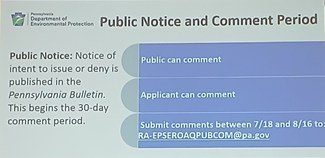
DEP will review all comments and draft a comment and response document. All commenters will receive a copy of the document.
Amazon’s proposed generator engines would only provide backup electricity to the data center in the event of a main utility power interruption and for limited testing and maintenance purposes of less than 10 hours per year, according to Amazon.
DEP Air Quality Program Manager Jillian Gallagher said her agency will ensure that Amazon complies with all state and federal laws, adding that her team “takes this job seriously.” If Amazon does not meet the requirements, DEP will not issue the permit.
Based on projected emissions, Gallagher said the data center would be considered a “minor facility,” in that it would produce less than 25 tons of nitrogen oxygen per year similar to the hospitals and universities in the area.
She described “major facilities” as those that produce more than 25 tons of nitrogen oxygen per year and said Waste Management, Wheelabrator and Fairless Energy are all examples of major facilities.
As part of Amazon’s permit, the company would be required to “do record keeping daily,” according to Gallagher. In addition, DEP staff would “do unannounced routine inspections at Amazon.” If violations were found, DEP would follow up and assess penalties, she said.
In addressing an audience member’s question, an Amazon representative said the company follows stringent guidelines for its emission calculations. Amazon source tests against “worst-case scenarios.”
“Even if the source test comes in cleaner, we will not claim anything lower than our permit states,” he said, adding that the company will use different parameters to monitor various factors, including the urea dosing rate, the catalyst bed temperature, “a lot of things that a lot of states don’t require.”
In addition to concerns related to air quality, potentially paying more for - and having adequate - water supplies were among the speakers’ most pressing concerns.
Morrisville Municipal Authority’s engineer, Bob Campbell, of Pennoni Associates, said that during its peak flow – on the hottest days of the year – Amazon is expected to use 4.4 million gallons of water per day, with 40 percent of the water expected to be returned through the industrial wastewater treatment plant. By comparison, Fairless Energy would use 5.5 million gallons of water on a peak day, he said. MMA’s customers collectively use 5.5 million gallons per day now. The facility has a capacity for 25 million gallons per day, Campbell said.
The industrial water system used at the data center, as well as other sites at the KTC, is separate from MMA’s drinking water system, which supplies drinking water to Morrisville, portions of Lower Makefield and Falls townships.
Amazon intends to rely on outside air cooling for about 94 percent of the year and only use water-based cooling during the hottest periods, approximately 6 percent of yearly operations.
The Authority can not accept biological discharge, only industrial wastewater, Campbell said, noting that “MMA is responsible for monitoring any discharge coming into the system.”
The audience grew louder during PECO representative Glen Murphy’s presentation, with many shouting out questions about rate increases as he spoke.
While data centers use between 10 and 50 times more energy than a similarly sized office building, Murphy told the audience that “it’s going to bring down rates a bit” since Amazon will be using more energy and “contributing more to the overall cost.”
A PECO double contingency peak load study evaluated the electric system on the hottest days of the year when it’s most stressed.
“We’re able to predict then what will fail on the system,” Murphy said, adding that troubleshooting helps PECO “get ahead of it and introduce projects that will address those issues.”
An independent study from PJM Interconnection, who operates the 13-state electric grid, supported PECO’s findings that there would be “no reliability issues” with powering Amazon’s data center.
“We’re not going to have any reliability issues that are different than what we have right now,” Murphy said.
System improvements were not needed for the first phase. The second phase entails strengthening the infrastructure, he said.
An audience member claimed that electric rates have increased by 50 percent within five years in areas where other data centers are located and asked Murphy how PECO would prevent that from happening.
“It really is the supply and demand,” Murphy said. “Locally the rates don’t change. For the distribution rates, they stay the same.”
However, any “large loads” within the PJM Interconnection 13-state service area “will have an impact on the electric rates here and everywhere within PJM.” In addition to Pennsylvania, PJM Interconnection includes New Jersey, Maryland, Delaware, Illinois, Indiana, Kentucky, Michigan, North Carolina, Ohio, Tennessee, Virginia, West Virginia, and District of Columbia.
Some speakers were concerned that a deluge of electricity to power the data center would result in skyrocketing rates for residential customers.
Amazon representative Becky Ford said that the community is not subsidizing the data center’s energy costs.
“We pay full energy costs for support of our site,” Ford said. “There is actually a recent study showing that customers are not burdened by the cost of data centers.”
Falls resident Amanda Westerman, who began the petition opposing the data center, announced that more than 4,000 people have signed it.
Several speakers called for a ban of Amazon while others demanded to know if Amazon collects and shares data with ICE agents.
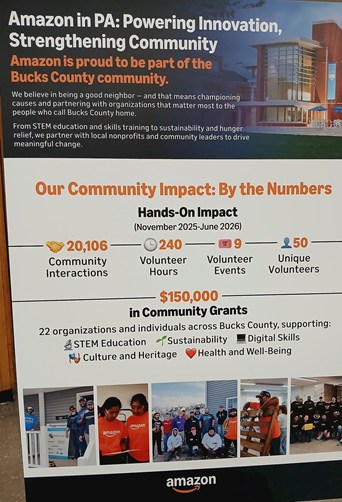
Ford said she could not share client information. Ford did share that to date, Amazon has invested more than $827 million on the Falls Township site, which will be 3 million square feet once complete. The data center is expected to create thousands of new full-time jobs. The site will be under active construction for the next two to three years.
Several New Jersey residents spoke Tuesday night, including Florence Township Mayor Kristan Marter.
“What rights do we have on the other side of the river and repercussions with regard to sound, light, air quality?” Marter asked. “We didn’t have a say.”
Falls Township Manager John Shepherd responded that complaints related to sound or light would be filed with Falls Township, while DEP would address air quality concerns.